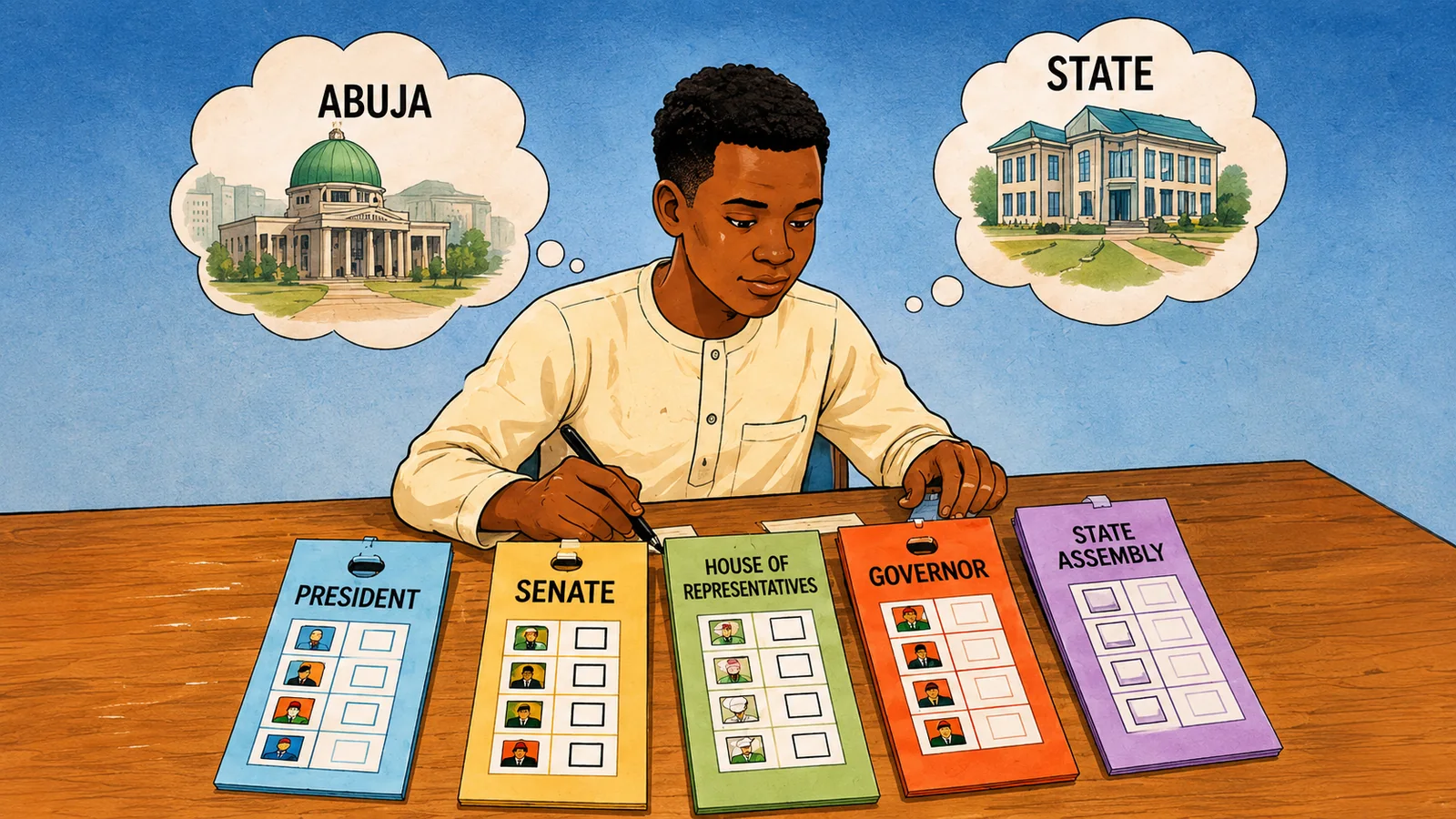

If you have ever wondered why Nigerian ballot papers are built around political parties—and why a person cannot simply put their own name forward as an independent—the answer is mainly constitutional, not an INEC preference.
Nigeria currently has no general legal route for independent candidacy in the major elective offices covered by the Constitution. For offices such as president and governor, the Constitution expressly ties qualification to political-party membership and sponsorship.
The Basic Rule
For the presidency, Section 131 of the Constitution includes party membership and sponsorship among the qualification requirements. The governorship provisions use the same basic party-sponsorship structure.
That means a popular individual cannot simply collect signatures, pay a fee to INEC, and appear on the presidential or governorship ballot without a registered political party behind them.
The important distinction is that this rule comes from the Constitution itself. INEC administers the election under that framework; it does not have power to waive a constitutional qualification because an independent candidate has enough supporters.
Why the Electoral Act 2026 Didn't Create Independent Candidates
The Electoral Act can regulate how elections are organised, how parties nominate candidates, how votes are counted, and how election offences are punished. But an ordinary Act of the National Assembly cannot simply override a qualification requirement written into the Constitution.
So even though the Electoral Act 2026 changed many parts of Nigeria's electoral system, it did not by itself create a general independent-candidate route for 2027.
To do that properly, Nigeria would need a constitutional alteration that changes the relevant candidate-qualification and sponsorship provisions, along with any supporting electoral legislation needed to make independent candidacy workable in practice.
Why People Keep Asking for Independent Candidacy
Supporters of reform usually make a few recurring arguments:
- party primaries and internal party structures can block candidates who have public support but lack influence inside a party;
- requiring party sponsorship limits the choices that can appear on the ballot;
- an independent route could give voters another option alongside the registered parties.
Opponents or sceptics raise different questions, including how independent candidates would qualify for the ballot, how serious candidates would be distinguished from frivolous ones, what nomination thresholds should apply, and how campaign finance and national-spread requirements would work.
Those are policy arguments. They do not change the current legal position.
What Would Actually Need to Change
This is where an important legal correction matters: presidential assent is not a required step in Nigeria's constitutional-alteration procedure under Section 9.
The National Assembly's own explanation of the process says a general constitutional alteration requires:
- approval by at least two-thirds of all members of the Senate;
- approval by at least two-thirds of all members of the House of Representatives; and
- ratification by resolutions of at least 24 of the 36 State Houses of Assembly.
After the required state ratification, presidential assent is not part of the Section 9 constitutional-alteration process.
That is different from an ordinary bill, which normally goes through presidential assent or the constitutional veto-override process.
Would a Constitutional Amendment Be the End of the Work?
No. If Nigeria created independent candidacy constitutionally, lawmakers and INEC would still need practical rules covering issues such as:
- how an independent candidate qualifies for the ballot;
- whether supporting signatures or deposits are required;
- campaign-finance and disclosure rules;
- ballot symbols and identification;
- substitution, withdrawal, death, and disqualification;
- how agents and candidate representatives operate at polling and collation centres.
In other words, changing the Constitution would create the legal possibility; detailed legislation and regulations would make the system function.
Does This Mean Voters Have No Alternative to the Biggest Parties?
No. Nigeria has multiple registered political parties, and smaller parties can sponsor candidates where they satisfy the law and INEC's nomination requirements.
But that is still different from a true independent candidacy. A candidate using a smaller party remains a party-sponsored candidate, even if the campaign is heavily centred on that individual's personal platform.
The "Small Party as a Vehicle" Workaround
In practice, politicians who cannot secure a ticket in a major party sometimes move to a smaller registered party to contest. That can make the campaign feel independent in political terms, but legally it is not an independent candidacy at all—the party is still the sponsoring vehicle that puts the candidate on the ballot.
That distinction matters when explaining the system to voters.
What About Defection After Someone Is Elected?
That is a separate constitutional issue. The rules governing an elected office-holder who later leaves the sponsoring party are not the same as the rules governing how the person got onto the ballot in the first place.
Independent candidacy is about ballot access before the election. Defection is about party affiliation after election or during a term.
What to Watch For
If independent candidacy moves from political discussion toward actual law, the signal to watch is a constitutional alteration proposal that successfully clears the special Section 9 process—not merely a speech, an INEC comment, or an ordinary Electoral Act amendment that leaves the constitutional sponsorship provisions untouched.
A serious reform would also have to explain the practical ballot-access rules that would accompany the constitutional change.
The Bottom Line
Nigeria does not currently provide a general independent-candidate route for the 2027 elections. The barrier is rooted in constitutional party-sponsorship requirements, so INEC cannot create independent candidacy on its own.
Changing the system would require a constitutional alteration approved by the necessary supermajorities in the National Assembly and ratified by at least 24 State Houses of Assembly. Presidential assent is not required for that constitutional-alteration process.
Last reviewed: 21 August 2026. Election dates, registration windows and polling procedures can change. Check INEC's official channels for the latest notice before acting.