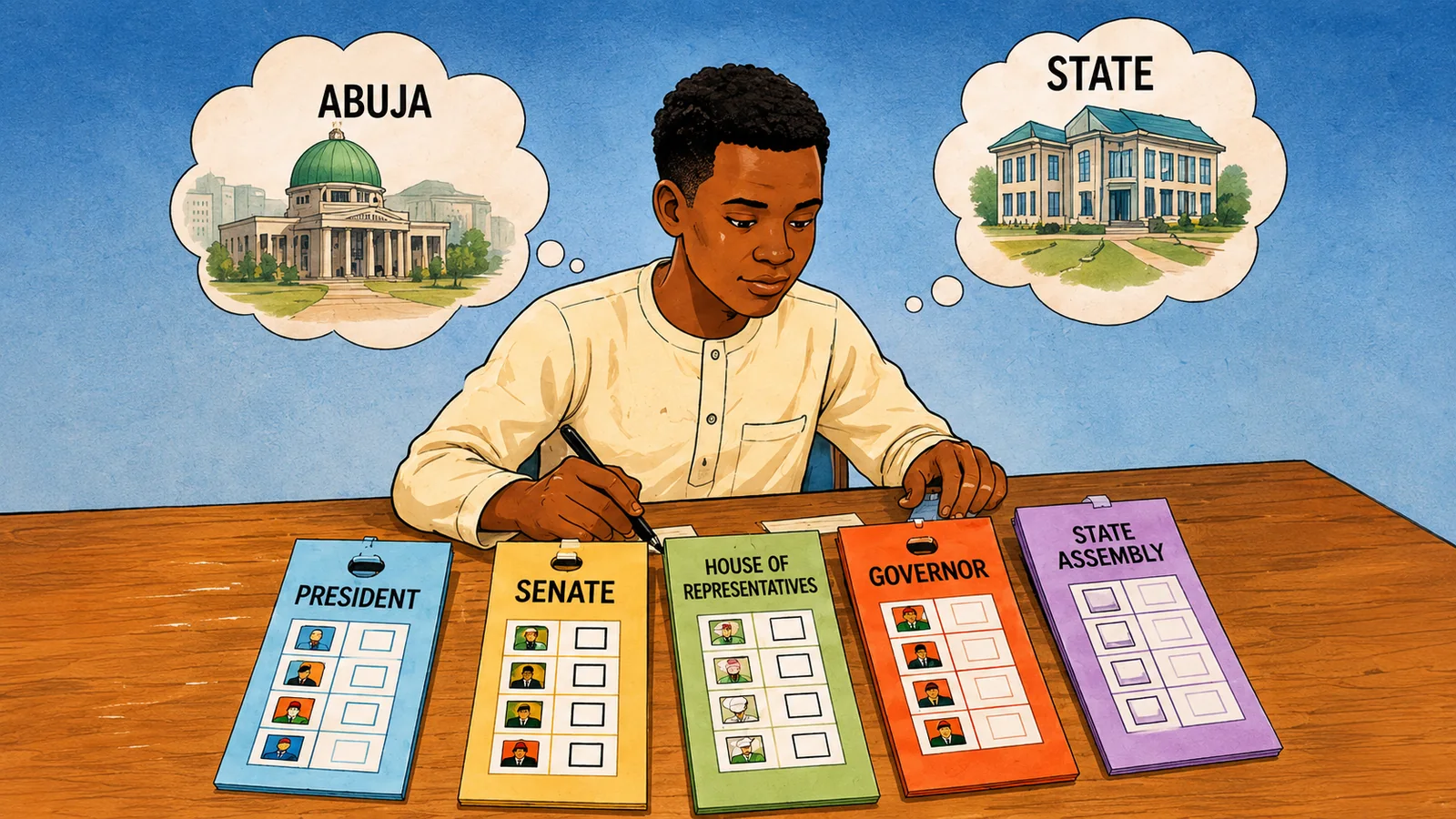
Nigeria's 2027 general elections aren't a single event — they're two separate election days, roughly three weeks apart, each covering different offices. Mixing them up is one of the most common sources of voter confusion, so here's a clear breakdown of what you're actually choosing on each date.
The Two Election Days
INEC's current calendar lists:
- 16 January 2027: Presidential and National Assembly elections
- 6 February 2027: Governorship and State House of Assembly elections
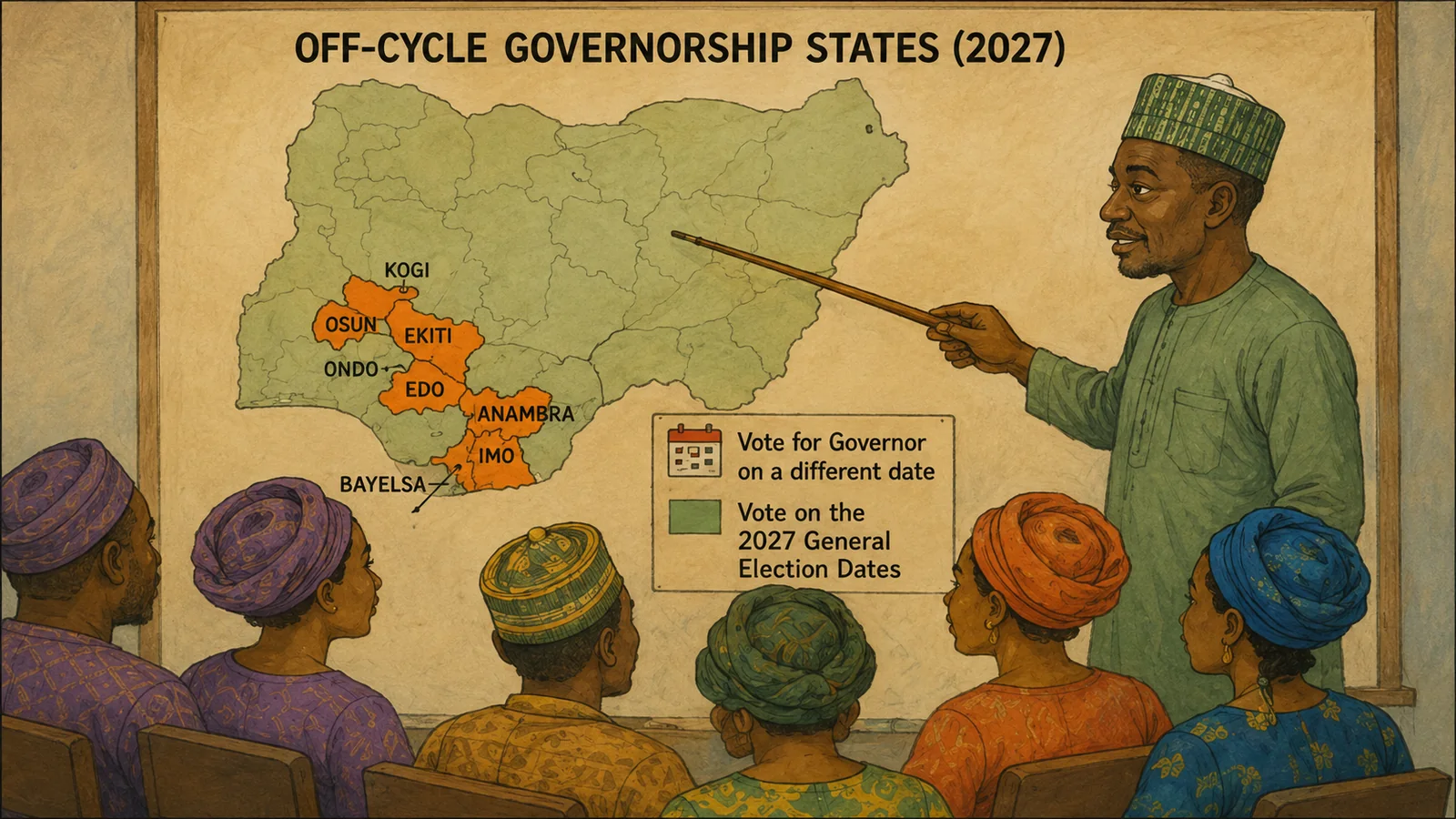
Not every state will have a governorship race on 6 February. Eight states—Anambra, Bayelsa, Edo, Ekiti, Imo, Kogi, Ondo, and Osun—run governorship elections on off-cycle calendars.
What You're Voting For on 16 January
President. One ballot, one national race, choosing Nigeria's head of state and head of government for the next four years. Every eligible voter in the country votes in this race, regardless of which state they're in.
Senate. Nigeria's Senate has 109 seats — three from each of the 36 states, plus one representing the FCT. You're voting for whoever represents your specific senatorial district within your state, not the state as a whole.
House of Representatives. The House has 360 seats, apportioned based on population across federal constituencies within each state. You're voting for whoever represents your specific federal constituency — a smaller, more local subdivision than a senatorial district.
All three of these races appear on your ballot on the same day, but they're separate ballots for separate offices, decided independently of one another. It's entirely possible for a state to vote one way at the presidential level and a different way at the National Assembly level.
What You're Voting For on 6 February
Governor. Your state's chief executive, if your state is holding a governorship election in 2027 — not all of them are (see the next section for why).
State House of Assembly. Your representative in your state's own legislature, distinct from the National Assembly in Abuja. State Houses of Assembly handle state-level laws and oversight, separate from federal matters.
If you're in one of the states not holding a 2027 governorship election, you'll still be eligible to vote in your State House of Assembly race on 6 February — that election runs on the same national cycle as the presidency and National Assembly, even in states where the governorship itself runs on a different calendar.
Why the Dates Are Split at All
This isn't a new complication introduced for 2027 — Nigeria has run its general elections this way since transitioning to the current format, with federal elections (president, Senate, House of Representatives) held first, followed by state-level elections (governor, state assembly) a few weeks later. The separation exists partly for logistics: running every office nationwide on a single day would multiply the strain on INEC's staffing, materials, and security resources beyond what's manageable, so splitting federal and state races into two rounds spreads that load.
It also has a practical benefit for voters and observers: separating federal from state races makes each individual result easier to track, verify, and collate cleanly, rather than trying to disentangle multiple simultaneous vote counts across every level of government at once.
Why This Confuses First-Time Voters Most
If you've never voted before, it's easy to assume "election day" is a single event where you make every choice at once, the way some other countries handle it. Nigeria's system asks you to show up twice within a few weeks, for a different set of offices each time — and if you only prepare for one of those days, thinking you're done after the January vote, you might miss your state-level vote in February without realising it was a separate obligation.
It's worth marking both dates now, treating them as two distinct commitments rather than one election with two touchpoints.
How Many Ballots Will You Actually Receive?
You are making separate choices for separate offices. The exact physical ballot-paper configuration and voting instructions for 2027 should be taken from INEC's final election-day guidelines and the instructions at your polling unit.
The important thing for a voter is not to treat one mark as covering every office. President, Senate, House of Representatives, governor (where applicable), and State House of Assembly are distinct contests with distinct results.
Does Your Vote Weight Differently Across These Races?
No — each race is decided independently by whoever gets the required outcome in that specific contest. Your presidential vote doesn't influence your Senate or House of Representatives result, and your governorship vote doesn't influence your State Assembly result. Each ballot you cast is counted, collated, and decided entirely on its own terms, all the way up through the collation chain for that specific office.
A Quick Way to Keep It Straight
A simple way to remember the split: January is federal, February is state. President, Senate, and House of Representatives are federal offices decided on 16 January. Governor and State House of Assembly are state offices decided on 6 February. If you keep that federal-versus-state distinction in mind, it's much easier to know exactly what you're choosing each time you're handed a ballot.
Why Turnout Sometimes Drops Between the Two Dates
The two election days require voters to make two separate trips to the polling unit, which creates a simple risk: some people pay close attention to the presidential/National Assembly election and then forget or deprioritise the state-level election.
Whatever the turnout pattern ultimately looks like in 2027, the second election day is not a continuation of your presidential vote. It is a separate opportunity to choose state-level representation.
The Bottom Line
Nigeria's 2027 elections span two separate dates covering five distinct offices between them: president, senator, House of Representatives member, governor, and state assembly member. Federal races happen first, on 16 January; state races follow on 6 February. Each is a genuinely separate vote, decided on its own, and treating them as one combined event is the easiest way to accidentally miss one of them.
Last reviewed: 21 August 2026. Election dates, registration windows and polling procedures can change. Check INEC's official channels for the latest notice before acting.