Nigerian election law has increasingly built in specific protections for voters who might otherwise face real barriers at a crowded, physically demanding polling unit. If you're elderly, pregnant, nursing, or living with a disability — or you're accompanying someone who is — here's exactly what you're entitled to.
Priority Access, Not Just an Informal Courtesy
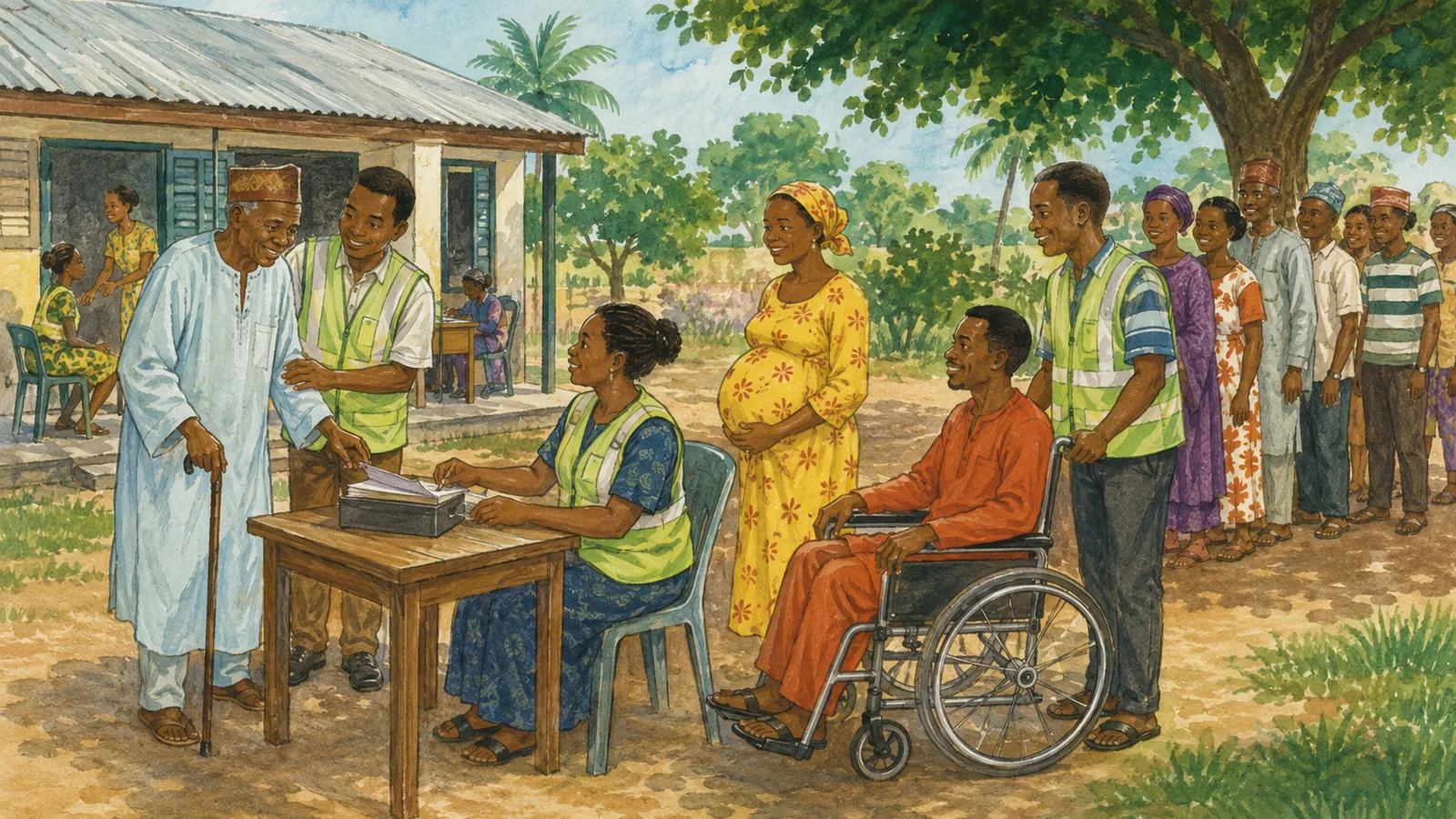
INEC's polling procedures provide priority treatment for voters who may face greater physical barriers in a long queue, including persons with disabilities, elderly voters, pregnant women, and nursing mothers.
It is useful to distinguish this operational priority arrangement from the specific statutory rights in Section 54 of the Electoral Act 2026. The Act expressly deals with assistance and accessibility for voters with disabilities and other incapacities; INEC's operational guidelines then add practical queue-management measures for other vulnerable voters.
If you need priority treatment, tell the officials on duty rather than assuming they will automatically notice your situation.
The Right to Bring an Assistant Into the Voting Cubicle
This is one of the most important and most specific protections, and it was actually strengthened under the Electoral Act 2026. Under Section 54 of the Act, a voter with visual impairment or another form of disability may be accompanied into the polling unit — and into the voting compartment itself — by a person of their own choosing, after informing the Presiding Officer. That companion can assist them in marking their ballot, preserving their ability to vote independently in substance even where they need physical help to do it.
The New Safeguard Against Manipulation
Here's what changed specifically in 2026: the law now explicitly bars any political party agent, candidate, or party official from serving as that companion or assistant. This proviso didn't exist under the 2022 Act — it's a genuinely new addition, introduced specifically to close a loophole where party representatives could offer to "help" a disabled or vulnerable voter mark their ballot and use that access to influence or observe their choice. Under the current law, your assistant has to be someone you choose freely — a family member, a friend, a caregiver — and cannot be anyone tied to a political party or candidate.
If anyone affiliated with a party or campaign offers to accompany you into the voting compartment "to help," that offer itself is against the law, regardless of how well-intentioned it might be presented.
Assistive Tools INEC Is Required to Provide
Section 54 requires INEC to take reasonable steps to assist voters with disabilities and specifically contemplates measures such as Braille, large embossed print, electronic devices, sign-language interpretation, or other appropriate assistance.
That legal duty does not mean every polling unit will necessarily contain every possible assistive device in identical quantities. If you need a particular form of assistance, ask the Presiding Officer what has been provided for that unit and make accredited observers aware of any serious accessibility failure.
The Broader Legal Backing
These protections don't exist in isolation — they sit within Nigeria's wider legal framework for disability rights, including the Discrimination Against Persons with Disabilities (Prohibition) Act 2018, and align with Nigeria's obligations under the UN Convention on the Rights of Persons with Disabilities, which recognises political participation as a right, not a privilege extended at the discretion of election officials. If you experience a polling unit failing to honour these protections, you're not just dealing with a local administrative failure — you're dealing with a violation of a right that has both domestic legislative and international backing.
What This Looks Like for Pregnant and Nursing Voters Specifically
Priority access for pregnant women and nursing mothers is generally about physical accommodation — recognising that standing in a long queue for hours isn't reasonable or safe for someone late in pregnancy or caring for a small infant on election day. If this applies to you, don't hesitate to identify yourself to officials and ask to be moved ahead of the general line, particularly if a queue is unusually long or slow-moving. INEC officials on duty are generally aware of this provision, but it still typically requires you to speak up rather than assuming you'll automatically be recognised and prioritised without saying anything.
What This Looks Like for Elderly Voters
The same priority principle applies to elderly voters, recognising that a long standing queue can be genuinely difficult or unsafe for someone with mobility limitations or health conditions common at an advanced age. If you're accompanying an elderly relative, it's entirely appropriate to ask officials on their behalf if they're not comfortable doing so themselves.
If These Rights Aren't Honoured at Your Polling Unit
Not every polling unit implements these protections consistently in practice, despite the legal framework being clear. If you or someone you're with is denied priority access, an assistant, or an assistive tool you're entitled to:
- Ask the Presiding Officer directly, referencing that this is a standard INEC provision, not a special favour.
- Involve accredited observers present, since accessibility gaps are specifically something disability rights and election monitoring organisations track and report on.
- Note what happened afterward, since documented accessibility failures at specific polling units contribute to pressure for better implementation in future cycles.
Planning Ahead Makes a Real Difference
If you know in advance that you or someone in your household will need any of these accommodations, it's worth thinking through the logistics before election morning rather than in the moment. Decide who your assistant will be if you'll need one in the voting compartment, so there's no confusion or last-minute substitution at the polling unit itself. If mobility is a concern, think about arriving at a quieter time within the accreditation window if possible, rather than during the heaviest early-morning rush, since a shorter wait for a priority slot is still easier to manage than a long one. None of this is required, but a little preparation tends to make these provisions work more smoothly in practice than showing up and hoping officials handle it well on the spot.
The Bottom Line
Voters with disabilities have specific statutory protections under Section 54 of the Electoral Act 2026, including assistance in qualifying circumstances and safeguards against a party agent, candidate, or party official entering the voting compartment as the voter's chosen assistant.
INEC's polling procedures also provide priority treatment for groups such as elderly voters, pregnant women, nursing mothers, and persons with disabilities. The practical lesson is simple: know what assistance you need, ask the Presiding Officer for it, and document a serious accessibility failure if the procedure is not followed.
Last reviewed: 21 August 2026. Election dates, registration windows and polling procedures can change. Check INEC's official channels for the latest notice before acting.