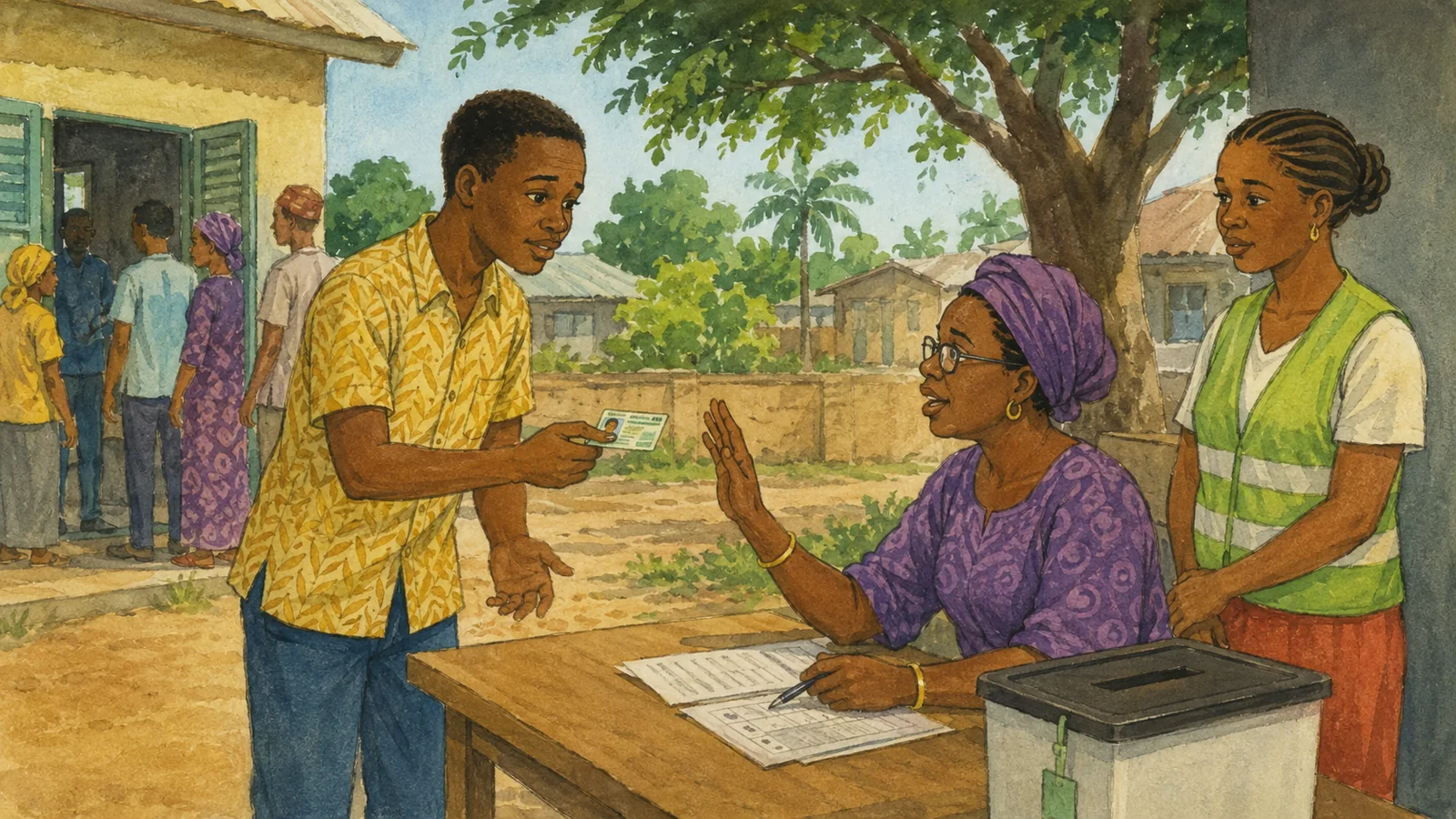
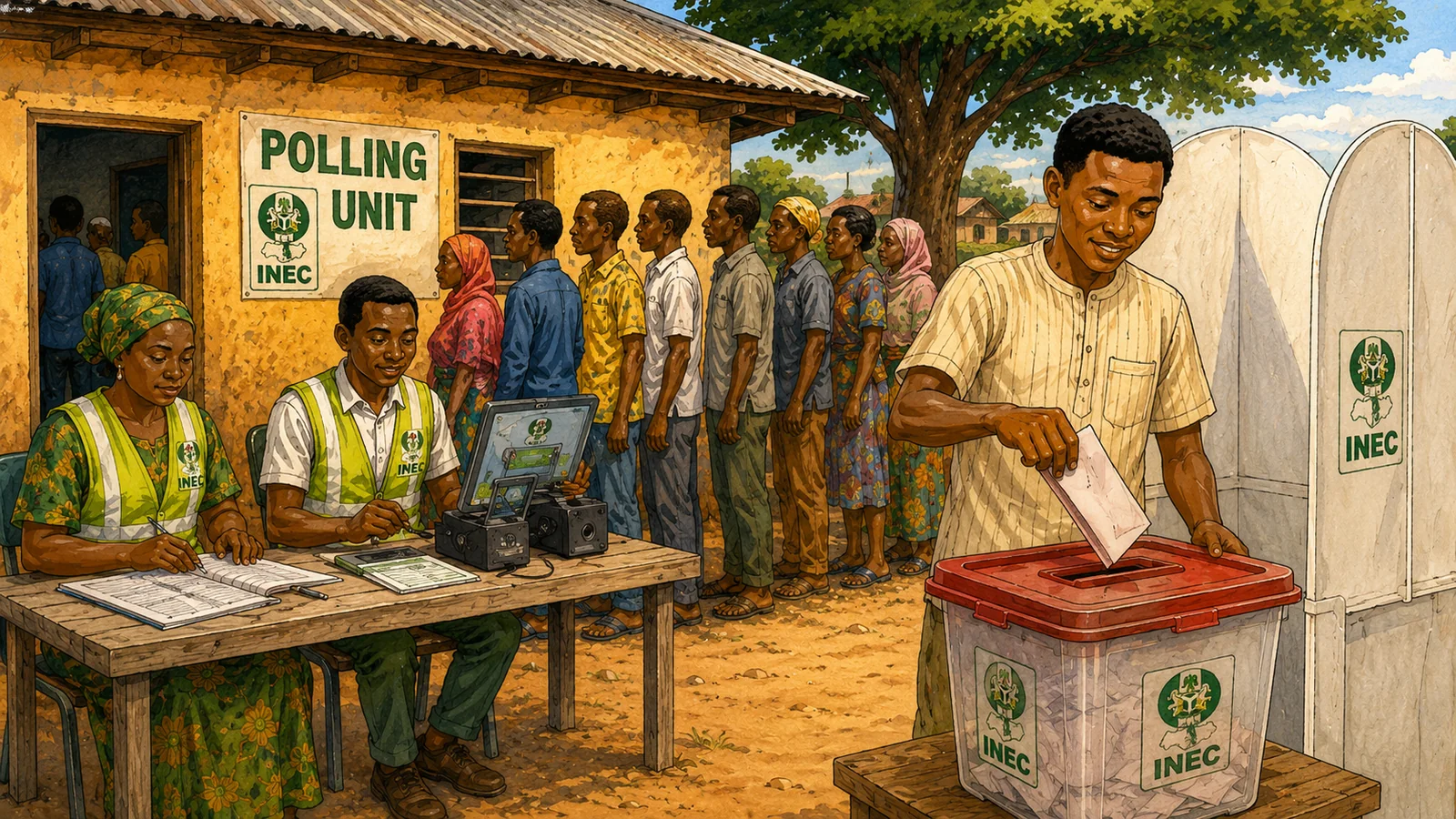
Knowing the process in advance makes the difference between walking through it confidently and feeling lost in the queue. Here's exactly what happens, in order, once you arrive at your polling unit — and how to get every step right.
Step 1: Find Your Name and Join the Queue
Confirm that you are at the polling unit assigned to your registration. You cannot simply choose a more convenient polling unit on election day.
INEC's recent continuous accreditation-and-voting model has generally used an 8:30 a.m. to 2:30 p.m. window, with people already in the queue at closing time allowed to complete the process. Check the final 2027 election notice for the exact operational hours that apply on the day.
Once you confirm the unit, follow the queue and voter-direction arrangements set by the polling officials.
Step 2: Accreditation With BVAS
When it is your turn, present your PVC for accreditation. Under the Electoral Act 2026, INEC uses BVAS or another approved technological device to verify voters before they can vote.
The device uses the voter record and biometric information available to INEC. If the first verification attempt does not work, follow the Presiding Officer's instructions for the permitted retry or alternative biometric process.
There is an important difference between your biometric match failing and the accreditation device itself failing for the polling unit. The Electoral Act contains rules for replacement or, where the device cannot be replaced, the handling of voting at the affected unit. Do not assume that an entire polling unit should simply continue with informal manual accreditation.
Step 3: Receive Your Ballot Paper
After successful accreditation, the election officials will issue the ballot paper or papers for the election taking place at that polling unit. Follow the Presiding Officer's instructions and check that you understand which contest you are voting in before entering the voting compartment.
Do not try to decide for yourself whether a ballot is legally valid because of a missing mark, stamp, or signature. The Electoral Act contains specific rules for how disputed or apparently unmarked ballot papers are treated during counting. If something about the paper concerns you, ask the Presiding Officer before you mark it.
Step 4: Cast Your Vote in Secret
Move into the voting compartment so your choice remains private.
- Find the party or candidate option you intend to vote for.
- Make your mark in the space provided, following the instructions given at the polling unit.
- Fold the ballot the way the Presiding Officer demonstrated or pre-folded it, so the mark does not transfer or become ambiguous.
Do not photograph your marked ballot. INEC prohibits camera-capable devices inside the voting cubicle because ballot secrecy must be protected and photographic "proof" can facilitate vote buying.
Step 5: Drop Your Ballot — In Full View
After folding your ballot, you leave the cubicle and drop it into the ballot box yourself, in full view of everyone present. This part is intentionally public: your choice was private, but the act of voting is witnessed, so no one can later claim ballots were swapped or the box was tampered with. You'll typically then pass a final official who confirms your ink mark before you're free to leave the polling unit.
What Makes a Vote "Spoilt" or Invalid
A ballot can be rejected if the voter's intention cannot be clearly determined or if it has been marked in a way that falls outside the legal rules—for example, a mark that appears to select more than one option.
If you accidentally spoil a ballot before casting it, do not try to repair it with crossings-out or extra marks. Tell the Presiding Officer immediately. The Electoral Act provides a process for an accidentally spoiled ballot to be returned and replaced where the officer is satisfied that the mistake was accidental.
That is very different from a ballot already placed in the ballot box: once cast, you cannot simply ask for another vote.
What Happens After You Vote
You don't need to stay, but if you're curious: once the queue closes, votes are sorted and counted right there at the polling unit, in the open, with party agents and any accredited observers present able to watch. The results are recorded on Form EC8A, signed by the Presiding Officer and the party agents on the ground, then publicly announced and pasted at the polling unit before that figure is used anywhere else in the count. The polling-unit result is then handled under INEC's physical collation process and the Electoral Act's electronic-transmission requirements, including transmission to the Result Viewing Portal (IReV).
What You Should Never Do
- Do not photograph your marked ballot or take a camera-capable device into the voting cubicle.
- Do not accept or offer money, gifts, or benefits in exchange for a vote. Vote buying and selling are electoral offences.
- Do not campaign or canvass in a way prohibited at the polling unit. Election-day rules restrict political activity around voting.
- Do not interfere with election officials, party agents, observers, other voters, or election materials. Raise concerns through the Presiding Officer and the proper reporting channels instead.
Your Rights as a Voter
You are entitled to cast your vote in secret if you are properly registered and accredited at the polling unit assigned to you. You can also raise a concern with the Presiding Officer if you believe the process is not being followed.
Party agents and accredited observers can observe, document, and call attention to irregularities, but they do not have authority to overrule INEC officials or decide whether you are eligible to vote.
If You're Turned Away
If you're told you can't vote, ask specifically why. A genuine mismatch between your details and the register is different from an official simply being unhelpful or trying to discourage you. Party agents and accredited observers can call attention to a possible irregularity and document what happens, but they cannot overrule the Presiding Officer or determine your eligibility. Ask that the issue be checked properly before you leave.
Last reviewed: 21 August 2026. Election dates, registration windows and polling procedures can change. Check INEC's official channels for the latest notice before acting.