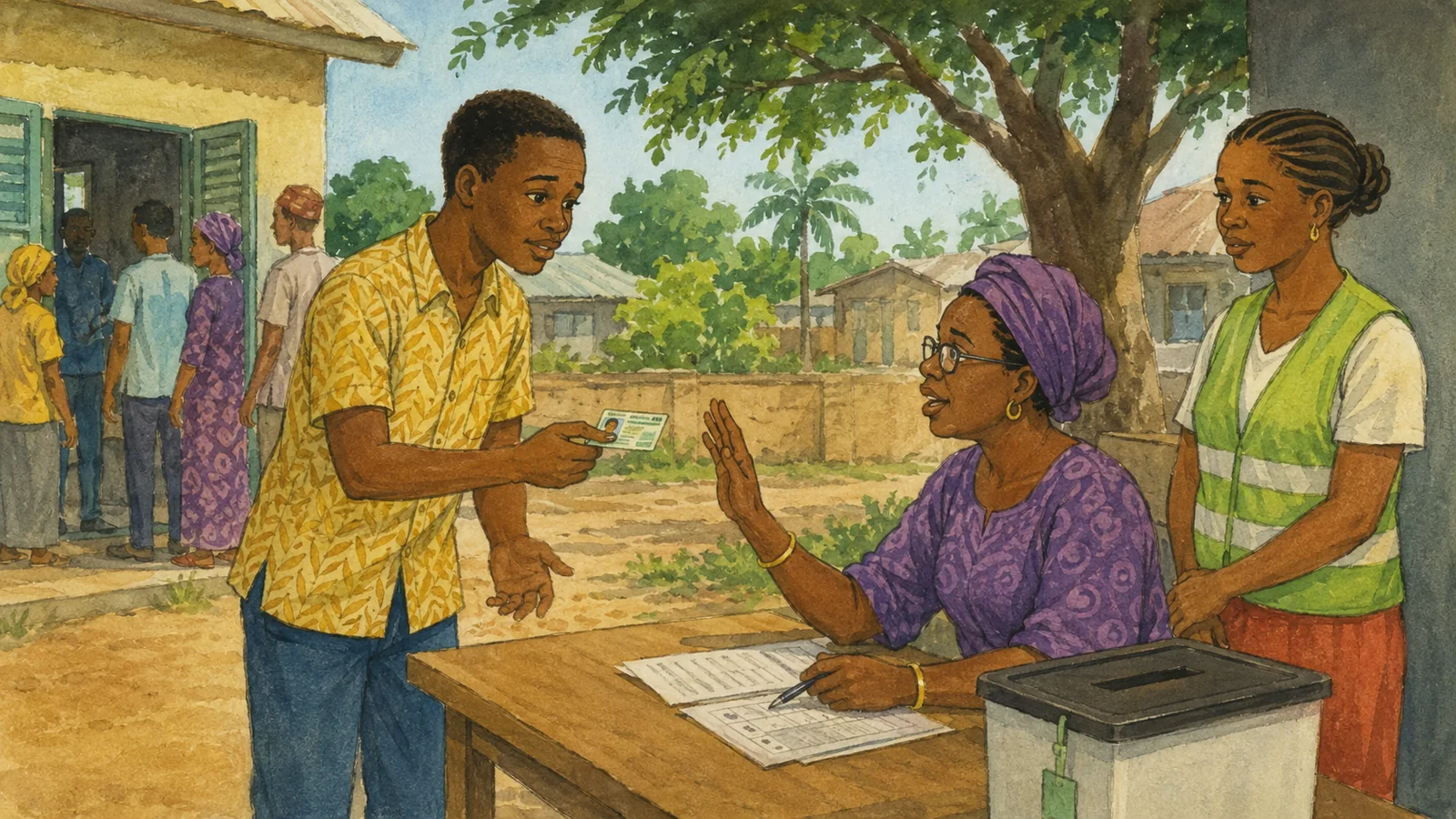
Being told you can't vote after you've prepared, queued, and made it to the front is one of the most frustrating things that can happen on election day. Most of the time, it's fixable on the spot if you know how to respond. Here's what actually causes this, and what to do about each cause.
First: Confirm You're Actually at the Right Polling Unit
The single most common reason people get turned away is the simplest one — they're at the wrong polling unit entirely. Your PVC specifies a particular polling unit, ward, and Local Government Area, and you can only be accredited and vote at that exact location, not at whichever one happens to be closest to you or where a friend or relative votes.
Before assuming anything has gone wrong, double-check your PVC against the location you're standing at. This single mistake accounts for a large share of election day frustration, and it's entirely preventable by confirming your polling unit in advance, well before election morning.
If You're at the Right Unit but Your Name Isn't on the Register
If you believe you are at the correct unit but your name cannot be found:
- Ask the Presiding Officer to explain the problem clearly. A spelling issue, wrong section of the register, or wrong polling unit is different from not being on the register at all.
- Show your PVC and your VIN if available. Ask officials to check the record carefully.
- Ask an accredited observer or party agent to note the issue if it appears irregular. They can observe, document, and raise concerns, but they cannot overrule INEC officials or add you to the register.
If the record genuinely does not show that you are entitled to vote at that unit, there may be no election-day method for creating a new registration. Record what happened and follow up with INEC afterward.
If BVAS Can't Verify You
If the problem is biometric accreditation, ask the Presiding Officer to follow INEC's approved verification steps and any permitted fallback biometric method.
There are two different situations:
- Your individual biometric match is unsuccessful. Officials should follow the approved accreditation procedure rather than inventing a manual workaround.
- The BVAS or approved accreditation device itself has failed. The Electoral Act contains rules for replacement and, where the device cannot be replaced, for how voting at the affected polling unit is handled.
If a device problem is affecting many voters, accredited observers and party agents can document what is happening, but the official response must come through INEC's process.
If You Arrive After 2:30 P.M.
INEC's recent continuous accreditation-and-voting model has generally closed the queue at 2:30 p.m., while allowing people already in the queue at that time to complete the process. Confirm the final 2027 operational notice because polling hours are set by INEC for the election.
Either way, arriving early gives you far more room to deal with a wrong location, a queue, or a technical problem than arriving near closing time.
If You Suspect Deliberate Obstruction
Occasionally, being turned away isn't a genuine administrative issue but appears to be a deliberate attempt to prevent someone from voting — this is a far more serious situation than an honest mismatch or technical fault. If you believe this is happening:
- Stay calm and avoid escalating into a confrontation, which rarely improves the outcome and can create safety risks.
- Immediately involve any accredited observers or party agents present, and ask them to document what's happening.
- Note everything you can afterward — time, location, names or descriptions of officials involved, and exactly what was said — for a formal complaint to INEC.
Election-related obstruction is taken seriously by both INEC and independent monitoring groups, and documented patterns of this kind of behaviour at specific polling units have led to results being challenged in past election cycles.
What If the Problem Is With the Materials, Not You?
Sometimes being turned away has nothing to do with your own registration or verification at all — it's because a polling unit has run out of ballot papers, is missing a functioning BVAS device, or hasn't received its materials on time. This is a different category of problem entirely, and it's not something you personally did wrong or can fix by arguing your case harder. In these situations:
- Ask officials directly what the plan is — INEC has procedures for resupplying materials or extending voting hours at affected units, though how quickly that happens varies.
- Stay at or near the polling unit if you're able to, since voting may simply be delayed rather than cancelled outright.
- If you have to leave and materials arrive later, check with neighbours or local news for updates on whether voting resumed at your unit before deciding you've missed your chance entirely.
Material shortages and equipment failures are exactly the kind of issue independent observer groups track closely across an election, since patterns of shortages concentrated in particular areas can itself become a point of scrutiny afterward.
Keep a Record Either Way
Whatever the outcome, if you're turned away for any reason, it's worth writing down what happened as soon as possible afterward while the details are still fresh — the time, the specific issue given, and who you spoke to. Even if it doesn't get you a vote that day, this kind of record can matter for broader accountability, whether through INEC's own complaint channels or through independent election observer reports.
The Bottom Line
Most cases of being turned away come down to a location mismatch, a register discrepancy, or a BVAS technical issue — all of which are worth calmly asking about and, in many cases, resolving on the spot with help from officials, party agents, or observers present. Confirming your exact polling unit well before election day, and arriving early rather than late, eliminates the two most common causes before they ever become a problem.
Last reviewed: 21 August 2026. Election dates, registration windows and polling procedures can change. Check INEC's official channels for the latest notice before acting.